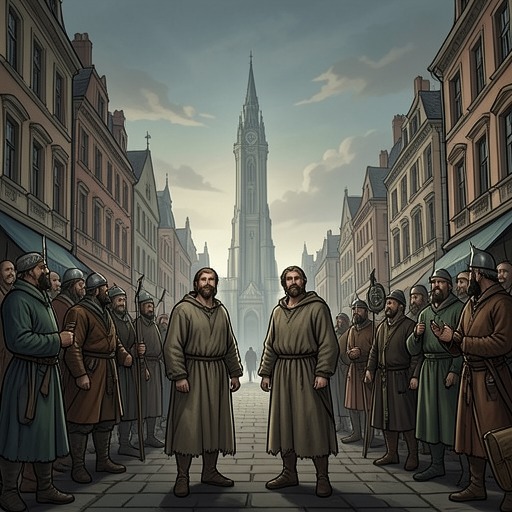
Ministry of the Two Witnesses
Book of RevelationThe Ministry of the Two Witnesses is a 1,260-day prophetic mission in which two figures testify on God’s behalf, wield powers against those who would harm them, and call judgments upon the earth. The study treats their ministry not as an isolated episode but as a long event whose beginning, duration, and ending help locate it within the author’s proposed chronology of the Great Tribulation. Its central interpretive claim is that the witnesses arrive shortly before the Rapture of the Church and die just before the seventh bowl of God’s wrath.
Chronological Placement
The study reads Revelation 11:1–14 as a passage that describes the witnesses’ entire 3.5-year period on earth, even though its events are not all presented as occurring at the same point in the larger timeline. In this account, the passage gives both the starting position of their ministry and advance information about its ending. The author therefore places the passage as an overlay on the sequence of end-time events, rather than treating every detail as a single, uninterrupted scene.
The proposed timing depends on the earthquake associated with the witnesses’ return to life. The study compares it with two severe earthquakes mentioned in Revelation: one at the sixth seal and another at the seventh bowl. It rejects the sixth seal as the likely point of the witnesses’ death because counting 3.5 years backward would put their arrival before the Antichrist’s arrival, which the author considers inconsistent with the judgments they bring. Instead, the study connects their return to life with the earthquake at the seventh bowl, which it describes as toppling the cities of the world. On that reading, their arrival belongs 3.5 years before the seventh bowl.
The author further places that arrival shortly before the midpoint of the seven-year period identified with Daniel’s seventieth week, and possibly a short time before the Rapture of the Church. This is the study’s interpretation of the prophetic sequence, not simply a duration stated by the vision: the text gives the witnesses 1,260 days, while the author uses the anticipated timing of their death and the earthquake to infer when that period begins. Their ministry thus serves as a chronological marker connecting the period before the rapture with the final bowl judgments.
Commission and Setting
The account opens with a command to measure the temple of God, its altar, and the worshippers within it. The outer court is excluded from the measurement and given to the Gentiles, while the holy city is to be trampled for forty-two months. The study presents this detail alongside the witnesses’ commission, placing their public testimony within a setting of contested sacred space and a fixed period of foreign trampling.
The two witnesses are appointed to prophesy for 1,260 days, clothed in sackcloth. The vision calls them the two olive trees and the two lampstands standing before the God of the earth. These images frame their work as testimony in God’s presence, while sackcloth marks the character of their prophetic appearance. Their assigned period matches the 3.5 years that the study uses in its timeline, linking the symbolic images and the time calculation to the same mission.
Powers and Testimony
The witnesses’ testimony is backed by extraordinary powers. If anyone tries to harm them, fire proceeds from their mouths and consumes their enemies; the passage states that anyone who would harm them must die in this manner. They can also shut the sky so that rain does not fall during their prophetic period, turn waters to blood, and strike the earth with plagues as often as they wish. The account presents these powers as protection and judgment attached to their testimony, not as separate episodes with independently specified dates.
The study connects this role to the wider period of divine judgment. It argues that the witnesses’ ability to withhold rain and call down plagues makes them instruments through whom God’s wrath is directed during the latter part of the tribulation years, alongside the angels who pour out judgments. In this interpretation, their ministry is therefore both prophetic and judicial: they announce their testimony, while the powers assigned to them make resistance consequential. The passage sets no separate schedule for each plague or act, so the study’s chronological claim concerns the overall 1,260-day ministry rather than a detailed sequence of individual judgments.
Completion and Consequences
The witnesses’ protection lasts until they have finished their testimony. Only then does the hostile power rising from the Abyss make war against them, overcome them, and kill them. Their bodies remain in the street of the great city, which the passage identifies spiritually as Sodom and Egypt and associates with the place where their Lord was crucified. The account says that peoples, kindreds, tongues, and nations see the bodies for three and a half days and do not allow them to be buried. This outcome marks a sharp reversal: the witnesses who could not be harmed during their testimony are killed once that work is complete.
The study’s chronology continues beyond the death scene. It identifies the witnesses’ return to life after three days with the earthquake associated with the seventh bowl, and uses that link to place their arrival 3.5 years earlier. Their death and return are thus treated as the endpoint that makes the duration of their ministry useful for ordering other events in Revelation. The witnesses’ episode also illustrates the study’s larger method: passages that appear to interrupt the sequence are repositioned as overlays, allowing details about a prolonged ministry and its ending to be read alongside the proposed timeline of the Rapture of the Church and the Seven Bowl Judgments.